
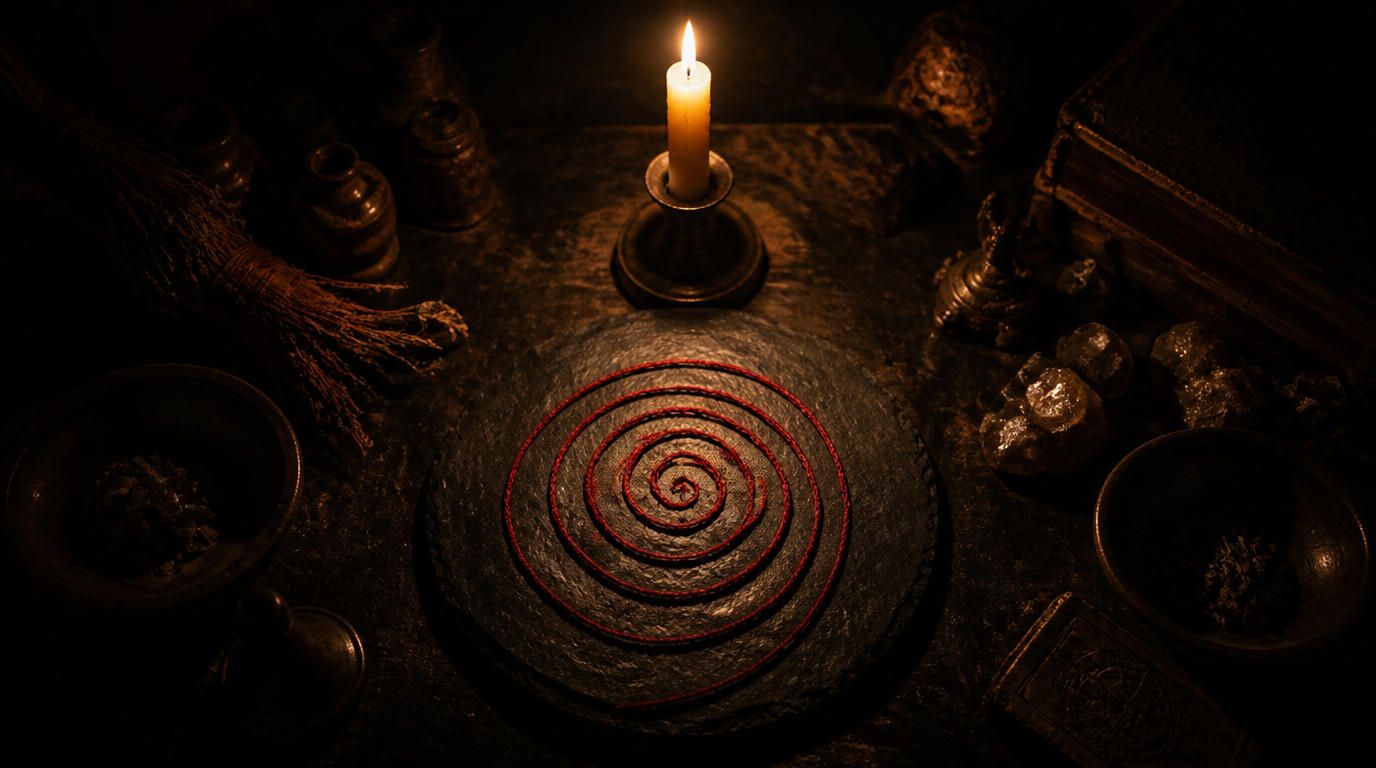
The thread is the central image of the love binding. It is found in esoteric texts of every age, in formulas handed down orally, in the language practitioners use to describe the work. Yet it is precisely this centrality that has encouraged a misunderstanding that recurs frequently: the idea that the thread and the chain are the same thing under different names. That the love binding is, in essence, a chain dressed up as a thread.
This guide analyses the distinction in depth. It is not a question of vocabulary. It is a structural difference in the field, in the nature of the operation and in the relationship between the two people whom a love binding involves. Understanding this difference is the starting point for understanding what the love binding really is in the doctrine of this Studio — and what it has never been.
What the thread is in the esoteric field
The thread is a symbol of correspondence. In terms of the field, a correspondence is a reciprocal resonance between two energy structures that share something: a history, a moment, an openness. Correspondences are not created from nothing — they are found. The work of the esoteric practitioner is to identify them, recognise them, and operate on them in order to amplify them.
The thread in the love binding represents this correspondence: a connection that already exists in the field between two people, built by the history they have shared, by the moments in which their fields opened to one another, by the resonances deposited over time. The thread is not created from nothing — it is recognised and strengthened.
The metaphor of the thread is precise not only in its symbolism but in its structure. A thread is light, it is flexible, it leaves both ends free to move. It does not hold by force — it holds by correspondence. A thread well stretched between two points that resonate with one another holds: not because it squeezes them, but because the two points are naturally drawn towards it.
This structure is the structure of the correct love binding: an operation that amplifies the existing correspondence between two fields, making it more perceptible to the person called, more present in the deep field, more capable of guiding behaviour towards rapprochement. It does not create something that is not there — it works on what is there.
What a chain is in the esoteric field
The chain is something else. The chain does not follow a correspondence — it imposes one. It does not rest on what exists in the deep field of two people — it attempts to force the field into a form that does not belong to it. The chain does not hold by resonance, it holds by force.
In terms of the field, an operation of the chain type is one that seeks to produce in an individual's field an orientation that finds no confirmation in any pre-existing resonance — that attempts to generate an attraction towards someone with whom the field has no history, no openness, no real energy point of contact. Or one that seeks to impose exclusivity, dependence, a deprivation of the individual's freedom of field — something that goes beyond the amplification of a correspondence and becomes coercion of the field.
The distinction is not always obvious to external observation. Two operations can look similar in ritual form and have radically different structures in the field. The difference lies not in the form but in the intention and in the field on which it operates: does it work on a real correspondence, or does it try to build something artificial? Does it amplify what is there, or impose what is not?
What the thread is and what it is not
The thread is an enhancement of correspondence. It is not a substitute for the absence of correspondence. If there is no common history between two people, no moment of mutual openness, no resonance in the deep field — the thread has no material to rest on. It cannot build a correspondence out of nothing.
The thread is reversible in the broadest sense: it does not bind permanently and absolutely. It amplifies resonances, but these resonances continue to be alive over time only if the history that generated them continues to be cultivated in reality. A field that draws closer through the binding and then builds nothing — does not communicate, does not meet, adds no history — tends to lose the enhancement over time. The thread does not replace real life between the two people.
The thread is not control over behaviour. It does not produce specific behaviours at specific times according to an external programme. It produces movements in the deep field that tend to express themselves in behaviours of rapprochement — but the manner, the rhythm, the specific form of those behaviours are determined by the individual field of the person called, not by the binding.
The thread is not an obligation. The person called is not "obliged" by the binding to do anything. The binding amplifies a resonance that this person already carries in their own field — and that amplified resonance expresses itself through the individual's freedom of field, not in spite of it.
Correspondence as a structural principle
The doctrine of the Studio rests on the ancient principle of correspondence: like acts upon like, and what is in resonance with something tends to draw near to it. This principle is not a trick of magic — it is a description of the structure of the subtle field.
In the love binding, correspondence operates on several levels. There is correspondence of history: the two people have shared events, moments, mutual openings that have left traces in the field of both. There is correspondence of temperamental resonance: their fields have a quality of affinity that allows them to come into contact naturally. There is correspondence of orientation: in the deep field of the person called there is an orientation towards the person who requested the binding, which the esoteric work can amplify.
These correspondences are the material of the binding. Without them, there is no field to work on. With them — especially when they are rich and deep — the binding has a great deal to rest on.
Correspondence is not perfect symmetry. It does not mean that both people feel exactly the same thing at every moment. It means that in the deep field of both there exists a reciprocal orientation — something that the field has deposited through the shared history and which does not disappear easily.
The principle of polarity in the thread
The thread is stretched between two polarities. In physics, a wire conducts energy between two points that have a difference of potential. In terms of the esoteric field, the love binding operates on a polarity between the person who requested the binding and the person who has been called: two fields that have already oriented themselves towards one another, but which for some reason are separated in the present moment.
Polarity is not antagonism — it is complementarity. The two fields do not oppose one another: they attract one another. The binding amplifies this latent attraction, the one already present in the deep field, bringing it to a level perceptible to the consciousness and behaviour of the person called.
When the polarity is weak — when the two fields have never built a significant resonance — the binding has little to work on. When the polarity is strong — a dense history, moments of great openness, deep resonances — the binding finds abundant material.
Polarity is assessed by looking at the shared history: how much time, how much intensity, how much real mutual openness there was between the two people. It is not assessed by looking at the intensity of the desire of the person who requested the binding — the desire of one person alone does not create a polarity of field.
Why the thread is not a chain: the equal dignity of both
The distinction between thread and chain has a precise ethical root, which in the doctrine of the Studio is expressed through the principle of the equal dignity of the two. Neither of the two is the matter of the other. Neither exists in the other's field as an object to be possessed or an instrument to be controlled.
This statement has precise consequences for the type of operation that belongs to the thread and that which belongs to the chain. The thread respects the freedom of the individual field of the person called — it does not bypass it, force it, or deprive it of the possibility of responding with its own specificity. The chain, by contrast, aims to eliminate that freedom — to produce a behaviour regardless of what the individual field supports.
The equal dignity of the two is not a limit of the binding — it is its structure. A binding that respects equal dignity operates on real correspondences and produces effects that are an expression of the individual's freedom of field, not of its deprivation. This type of binding is not only ethically coherent — it is also operatively more effective, because it rests on real field structures instead of trying to force non-existent ones.
The thread and time: how correspondence manifests
The correspondence amplified by the binding does not, in most cases, produce instant effects. The deep field moves first — resonances are activated, intensify, begin to guide the orientation of consciousness. Then, progressively, these deep movements reach the surface of behaviour.
This rhythm — deep field moving first, visible behaviour following — is the typical temporal structure of the thread. It is not the structure of an order given and immediately carried out. It is the structure of an amplification that propagates through the layers of the field from the deepest to the most superficial.
Latency — the period between the binding and the first visible signals — reflects this process. It does not indicate that the binding is not working: it indicates that the field is a complex system that takes time to bring deep movements to the surface.
The time of the thread is therefore an organic time — it follows the rhythm of the field, not the desire of the person who requested the binding. As analysed in detail in the article the timing of a love binding, phase by phase, calibrating expectations to this organic rhythm is a fundamental part of reading the process correctly.
What happens when the chain takes the place of the thread
There are situations in which the person seeking a love binding is not in fact trying to amplify a correspondence — they are trying to build a dependence, to impose control, to eliminate the other's freedom. These situations belong to the category of the chain, not the thread.
The signs of this confusion in the field of the request include: the intention to ensure that the person called "cannot be with anyone else", the desire to "possess" the other exclusively regardless of what the other wants, the wish to obtain a specific behaviour that no field resonance would naturally support.
In the doctrine of the Studio, these intentions correspond to what is called dark binding — not for abstract moralistic reasons, but for reasons of the field: they operate on structures that do not correspond to the nature of the esoteric field and produce consequences in the field of the person requesting them that a binding by correspondence does not produce. As analysed in the article white love binding and dark binding, the distinction is structural, not aesthetic.
Phases of the thread: how it is built and how it is maintained
The thread is not a single event — it is a process. It is built in phases that correspond to the progression of the field from deep amplification to surface emergence.
The first phase is that of rooting: the binding identifies the correspondences present in the field and amplifies them in the deep layers. In this phase nothing visible happens yet — the field is in motion but behaviour has not yet responded.
The second phase is that of propagation: the amplified resonances begin to guide the orientation of the consciousness of the person called. More vivid dreams, coincidences and indirect curiosity begin — the signals analysed in detail in the article signs that a binding is working.
The third phase is that of emergence: the movements of the deep field reach the surface of behaviour. The person called begins to seek contact, to communicate with a different quality, to move towards the person who requested the binding. This phase has its own rhythms and oscillations — advances and withdrawals are part of the process.
The fourth phase is that of stabilisation: the field reorganises itself into a stable structure of connection. The thread no longer has to work — it is the structure of the field that sustains the connection. The duration of this stabilisation depends on how far the real history between the two people continues to feed the field.
The signs that the thread is working
The signs of the thread at work are signals of the field — not promises of a result, but indicators that the resonances are moving. As already described systematically in the article signs that a binding is working, these signals appear on several levels: in dreams, in the subjective quality of the perceived field, in the behaviour of the person called.
Signals in dreams are typically the earliest: the person called appears in dreams with a quality of vivid presence, different from the ordinary dream. The person who requested the binding may experience a quality of intense connection during sleep — as described in the article love binding and dream interpretation.
Signals in the behaviour of the person called include the resumption of contact (even indirect), a change in the quality of existing interactions, a more attentive and more personal presence. They are not always evident in the first moments — they often begin as small changes that are difficult to observe without methodical attention.
Signals in the subjective quality of the field are those that the person who requested the binding perceives internally: a different quality in their own thoughts about the other person, a livelier sense of connection, a softening of obsessive anxiety in favour of a calmer presence.
Errors in reading the thread
The main error in reading the thread is to interpret it as a chain — to expect an immediate and total effect on the behaviour of the person called, a mechanical and programmed response, a form of control. When this expectation is not fulfilled, it leads to the mistaken conclusion that the binding does not work.
A second frequent error is to confuse the thread with desire: the intensity of your own desire towards the person called is not an indicator of the strength of the thread. The thread is measured by the quality of the field between the two people — by the depth of the existing resonances — not by the intensity of the desire of one party alone.
A third error is to interpret every movement of the field as confirmation of the thread at work. As analysed in the article when coincidence is not confirmation, not every coincidence or ambiguous signal should be promoted to proof of the process. Methodical observation over time — not the exalted interpretation of a single event — is the correct instrument.
The limits of the thread
The thread has real limits, which the doctrine of the Studio does not hide. A thread that finds no real correspondences in the field cannot produce stable effects. A field that has truly closed — in which the person called has genuinely worked through the separation and reorganised deeply — offers resistances that the thread alone cannot necessarily overcome.
The thread does not replace real life between the two people. It can open a door — but what happens through that door depends on the concrete behaviour of both, on the quality of real meetings, on the ability to build a new history that adds fresh correspondences to the field.
The thread does not produce a guaranteed result. It works on probabilities and resonances — not on certainties. The honest assessment of the starting conditions — how much shared history exists, how deep that history was, how far the field of the person called is still in resonance — is the most correct way of calibrating expectations. As analysed in the article love binding: what it is and how it works, esoteric work is an intervention on the real field, not a promise of outcome.
Finally: a strong feeling towards someone does not give the right to build a thread if that person has clearly signalled that they do not want this connection. Respect for the person who does not wish to be called — as analysed in the article love binding and respect for the person who does not want to be called — comes before the thread. Always.
FAQ: frequently asked questions on the thread in the love binding
Do the thread and the chain produce different effects in the field?
Yes, and radically different ones. The thread works on real correspondences — it produces movements in field structures that already exist and amplifies them. The chain attempts to create structures the field does not support, and this attempt produces in the field of the practitioner and of the requester very different effects — often undesirable in the long term — which the thread by correspondence does not produce.
If there has never been a history between me and the person called, can the thread work?
The thread works on pre-existing correspondences. If between the two people there has never been a moment of mutual openness, an interaction that deposited resonances in the field, a contact that left traces — the thread finds no material to rest on. It is not that it "does not work" — it is that it has no field to work on. As analysed in the article love binding on someone you have just met, the brevity of the shared history is one of the most real limiting factors.
Does the thread hold over time without reinforcement?
It depends on what happens in the real field after the thread has produced its effects. If the rapprochement leads to a concrete history — meetings, communications, shared experiences that add fresh correspondences to the field — the thread consolidates and needs no reinforcement. If the rapprochement remains at the level of the field without translating into real life, the enhancement tends to weaken over time.
How do I tell whether I am seeking a thread or a chain?
The question to ask is: do I want the other person to come towards me through their own freedom of field — feeling something that already exists in their deep field — or do I want them to be compelled to behave in a certain way regardless of what they feel? The first intention corresponds to the thread. The second to the chain. The honest answer to this question reveals the nature of the request.
Can the thread be cut by the other person?
The field of the person called retains its own autonomy. If that person, in the deep field, builds a genuine closure — not superficial but deeply worked through — the resonances on which the thread operates diminish. It is not an intentional "cutting" of the thread — it is the natural evolution of that person's field. As analysed in the article love binding and free will, the freedom of the individual field always remains.
